Understanding the Role of Baby Playpens
Choosing the right play area for your baby is a critical aspect of parenting. Baby playpens offer a secure, controlled environment where infants and toddlers can explore, play, and develop essential skills safely. They provide parents with a designated space where toys are contained, hazards are minimized, and supervision becomes more manageable.
Playpens are more than a containment tool—they are a developmental aid. They allow babies to engage with age-appropriate toys, practice motor skills, and build confidence in a safe, stimulating environment. As children grow, the role of a playpen evolves, adapting to new stages of mobility and curiosity. Understanding the appropriate age for using a playpen ensures that parents maximize both safety and developmental benefits, creating a balance between supervision, exploration, and learning.
By carefully considering factors such as age, physical and cognitive development, and household environment, parents can select a playpen that supports a child’s growth while providing peace of mind.
The Ideal Age Range for Baby Playpens
Newborns and Infants (0–6 Months)
For newborns, playpens primarily serve as a secure space for short periods of supervised rest rather than active play. During this stage:
Babies are limited in mobility, spending most of their time sleeping or participating in gentle tummy time exercises.
A playpen with a soft, padded base ensures comfort and safety during these periods.
While infants are not yet actively exploring, a playpen provides a boundary that keeps them safely away from hazards, allowing parents to complete short tasks without compromising supervision.
Choosing materials that are soft, non-toxic, and hypoallergenic is especially important for newborns, as their skin is sensitive and prone to irritation.
Crawlers and Early Walkers (6–12 Months)
As babies begin to crawl, sit independently, or pull themselves up:
Baby playpens become essential for safe exploration and physical development.
A contained environment allows infants to practice crawling and standing while reducing the risk of injury from household hazards like stairs, sharp furniture edges, or electrical outlets.
Interactive panels, soft toys, and sensory elements within the playpen can stimulate cognitive development and improve hand-eye coordination.
Parents should consider playpens with moderate-height walls and secure gates to prevent escapes while still allowing visibility and access.
Toddlers (12–24 Months)
When children reach the toddler stage:
Mobility and curiosity increase dramatically. Toddlers explore more actively, climb, and may attempt to push boundaries.
Playpens designed for this age should have sturdy, reinforced panels and reliable locking mechanisms.
Expandable or modular playpens provide additional space to accommodate active toddlers, allowing room for physical activity, coordination exercises, and interactive play.
At this stage, a playpen can serve not only as a play space but also as a secure zone for rest or brief learning activities.
Beyond 2 Years
Most toddlers outgrow traditional playpens around age 2.
Continued use may require larger, reinforced playpens designed for older toddlers.
Parents may transition children to alternative safe play areas, such as toddler playrooms, gated sections of the home, or activity centers that offer more freedom while maintaining safety.
Even at this stage, a playpen can remain a useful tool for structured activities or controlled play periods, especially in busy households.
Factors Determining Playpen Suitability
Baby’s Physical Development
The appropriate use of a playpen depends on the baby’s physical milestones:
Babies who can roll, sit, crawl, or stand independently require playpens that provide stability and sufficient space to move safely.
Playpens should accommodate increasing mobility without risking tipping or injury.
Assessing physical abilities ensures that the selected playpen offers both security and freedom of movement.
Parents should check manufacturer recommendations for weight and height limits to match the child’s current stage of development.
Cognitive and Sensory Development
Playpens also play an important role in cognitive and sensory growth:
Age-appropriate toys and interactive panels within the playpen support fine motor skills, hand-eye coordination, and early problem-solving abilities.
Sensory play, such as touching different textures or manipulating simple objects, encourages curiosity and learning.
A properly arranged playpen encourages independent exploration while keeping developmental goals in mind.
Safety Considerations
Safety is a primary concern when selecting a playpen:
Panels must be sturdy and stable, able to withstand leaning, climbing, or pushing.
Gates should be child-proof but convenient for adult access, using reliable locking mechanisms.
Avoid playpens with gaps, sharp edges, loose screws, or small detachable parts that could pose choking hazards.
Always follow manufacturer guidelines regarding maximum weight and height limits.
Home Environment and Supervision
The playpen should fit comfortably in the intended space without blocking household movement.
Floor surfaces should be considered: carpeted floors offer cushioning, while hardwood floors may require additional padding.
Ease of access for caregivers is essential to allow prompt attention and supervision when needed.
Signs Your Baby is Ready for a Playpen
Identifying readiness ensures that the playpen is introduced safely and effectively:
The baby can sit or crawl independently, demonstrating sufficient stability.
Shows curiosity and interest in exploring toys and surroundings.
Becomes restless or attempts to move toward unsafe areas when unsupervised.
Parents can confidently monitor the child without needing constant physical intervention.
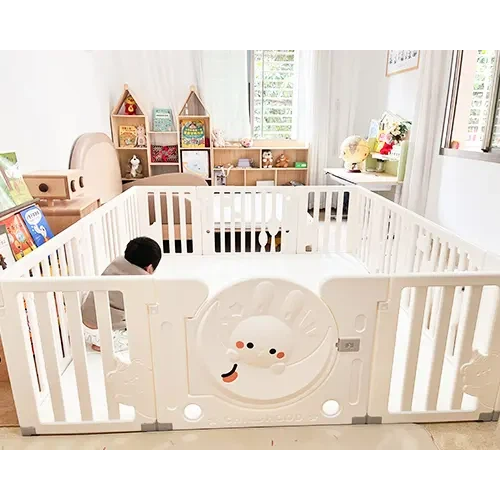
Transitioning Out of a Playpen
As children grow, parents should recognize when a playpen is no longer suitable:
Climbing over panels or repeated attempts to exit indicate the child may have outgrown the playpen.
Alternative safe play solutions include baby gates, designated playrooms, or age-appropriate activity centers.
Transitioning should be gradual, maintaining safety while allowing freedom for increased exploration.
Even after leaving the playpen, parents should ensure a controlled environment with soft surfaces and age-appropriate activities.
Age-Appropriate Playpen Features
Age Range |
Recommended Playpen Features |
Key Considerations |
0–6 Months |
Padded mats, enclosed sides, minimal toys |
Supervised rest, soft surface, safety-first design |
6–12 Months |
Interactive panels, cushioned base, moderate-height walls |
Supports crawling, standing, and early sensory play |
12–24 Months |
Sturdy panels, expandable/modular design, child-proof gates |
Accommodates climbing, active play, and increased curiosity |
2+ Years |
Large modular designs, reinforced materials, open yet safe space |
Transition to safe play areas beyond the playpen while maintaining security |
Selecting features appropriate for age ensures both safety and engagement, enabling the playpen to meet evolving developmental needs.
Maintenance and Hygiene for Age-Specific Playpens
Cleaning Panels and Mats
Regular cleaning is essential to prevent bacteria, allergens, and dust accumulation.
Wipe panels with baby-safe disinfectants; removable mats should be machine washable or easily cleaned.
Clean interactive toys regularly to maintain a hygienic environment.
Inspection for Wear and Tear
Examine panels, locks, and gates weekly for stability and integrity.
Ensure mats remain flat and securely positioned to prevent tripping hazards.
Promptly replace any worn or damaged components to maintain safety standards.
Longevity and Value
Investing in a durable playpen ensures multiple years of use, supporting different stages of growth.
Modular and expandable designs provide long-term adaptability, reducing the need for frequent replacements.
A high-quality playpen offers both developmental support and household convenience over time.
Conclusion
Selecting a baby playpen at the right age is essential for ensuring your child’s safety, promoting developmental growth, and providing convenience for parents. By assessing physical and cognitive milestones, the home environment, and supervision needs, parents can choose a playpen that perfectly matches their baby’s current stage. A thoughtfully selected playpen offers a secure, stimulating space for independent play, encourages motor skills and cognitive development, and helps families maintain an organized and safe household.
For parents seeking high-quality, durable, and versatile playpens, Wenzhou Fanle Education Technology Co., Ltd. provides expertly designed options that prioritize safety, comfort, and adaptability. Their playpens are crafted from non-toxic, child-friendly materials and designed to grow with your child, ensuring long-term usability and peace of mind.
To explore their range of products or get professional guidance on selecting the ideal playpen for your baby, parents are encouraged to reach out directly to Wenzhou Fanle Education Technology Co., Ltd.. Their experienced team can help you find the perfect solution that meets your baby’s developmental needs while creating a safe and engaging play environment at home.
FAQs
Q1: At what age can a newborn use a playpen?
Newborns can use a playpen for supervised rest or brief play periods on a padded surface.
Q2: When should a crawling baby start using a playpen?
Typically around 6 months, once the baby can sit or crawl independently.
Q3: How long can toddlers safely stay in a playpen?
Most toddlers can safely use a playpen until around age 2, depending on mobility and playpen size.
Q4: Are there weight or height limits for playpens?
Yes, always follow manufacturer guidelines to ensure safe use.
Q5: How do I know when my child has outgrown the playpen?
Climbing over panels, repeated attempts to exit, or rapid growth beyond the playpen’s dimensions indicate it’s time to transition.
Q6: Can playpens support cognitive development?
Yes, interactive panels and age-appropriate toys help develop motor skills, hand-eye coordination, and spatial awareness.
Q7: How should I maintain hygiene for a playpen?
Regularly wipe panels and gates, machine-wash mats, and sanitize toys to maintain a clean and safe environment.
Q8: What features should I prioritize for different ages?
Choose padded mats and enclosed sides for newborns, interactive panels for infants, sturdy expandable designs for toddlers, and reinforced modular playpens for older children.


