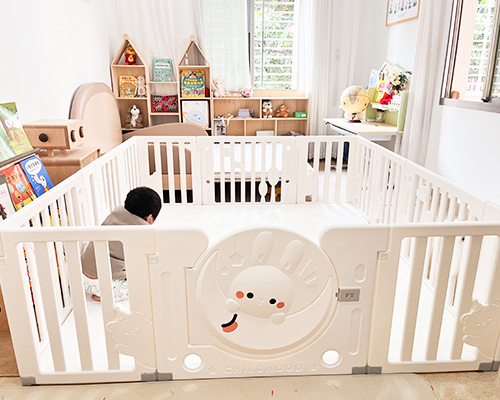
Transitioning a baby from a stationary bouncer to an active crawler requires a secure, designated play space. Parents are immediately forced to choose between rigid modular systems and soft-sided enclosures. This early decision heavily shapes your daily routine. Setting up an indoor playroom involves highly specific physical challenges. You must balance available floor space, daily cleaning realities, and structural integrity. A simple barrier fails if it slides across the floor or blocks crucial walking pathways. Selecting between a plastic and fabric play fence isn't about finding the objectively best product. It is about matching material properties to your specific flooring, room layout, and cleaning bandwidth. Understanding these structural differences ensures your child stays secure while you maintain peace of mind.
Key Takeaways
Plastic fences offer modularity, easier daily wipe-downs, and shape customization, making them ideal for hard floors where suction cups can grip.
Fabric/mesh fences provide a lightweight, visually unobtrusive, and impact-absorbing barrier, best suited for carpets or parents who prioritize a single, fixed-footprint setup.
The primary failure point for a toddler safety fence is improper floor matching (e.g., using suction-based plastic on high-pile carpets or placing lightweight fabric structures on slick hardwood without a mat).
Longevity depends on the child's climbing habits; rigid panels support early standing, while mesh prevents footholds.
Evaluating Baseline Criteria for an Indoor Play Fence
Establishing a reliable containment zone requires meeting strict baseline criteria. Hardware must remain uncompromised under daily stress. Panels should provide sufficient height to deter early escape attempts. You must also verify the structure presents zero pinch hazards around hinges or joints. These fundamental safety markers separate premium products from unreliable alternatives. Assessing these factors guarantees the space remains a safe haven rather than a structural hazard.
Space and footprint realities drastically dictate your final choice. A typical indoor play fence interacts heavily with existing furniture. You must account for door clearance, sofa placements, and walking paths. Large enclosures often dominate shared living spaces. They carry significant "visual weight" compared to smaller, discreet baby gear. Dedicated playrooms allow for expansive boundaries. Shared living rooms usually demand compact or easily dismantled solutions. Visual impact matters when adults share the same relaxation space.
The critical relationship between flooring material and structural integrity cannot be ignored. Flooring directly dictates how well a barrier resists pushing forces. Hardwood, tile, carpet, and foam mats all interact differently with base joints. A sturdy enclosure on hardwood might become a flimsy sliding hazard on plush carpet. Identifying your specific floor type is the first mandatory step before evaluating material options.
Core Success Markers
Hardware features concealed locking mechanisms.
Minimum height reaches the standard 24 inches.
Joints lack gaps where small fingers could get pinched.
Materials hold recognized safety certifications.
The Case for the Plastic Play Fence: Modularity and Maintenance
Plastic enclosures rely on interlocking High-Density Polyethylene (HDPE) panels. This structural mechanics approach distributes force evenly across multiple connection points. When a toddler pushes against one section, the adjacent panels absorb and deflect the energy. HDPE provides exceptional durability while remaining lightweight enough for adults to maneuver. This material resists denting, cracking, and moisture penetration. The hollow double-wall construction adds structural rigidity without adding excessive mass.
You gain significant advantages regarding spatial flexibility and sanitation. The ability to customize the footprint allows you to navigate tricky room corners. You can easily remove two panels to fit a small apartment living room. Later, you can add those panels back to scale the size as the child grows. Sanitation requires minimal effort. You effortlessly wipe down sudden spills, vomit, or marker stains. No machine-washing or disassembly is required. Furthermore, rigid top rails actively assist infants pulling themselves up to stand. This promotes independent cruising along the sturdy perimeter.
However, this rigid modularity introduces specific risks and limitations. Traction dependency remains the biggest hurdle. The design requires a non-slip play fence base, usually utilizing rubberized feet or suction cups. These grips only work on flat, non-porous surfaces like tile or sealed hardwood. Suction cups fail entirely on rugs or textured carpets. Climbing hazards also present a significant issue. Many manufacturers include cutout patterns designed for aesthetic appeal. These decorative holes inadvertently create perfect footholds for agile toddlers. Once disassembled, the rigid panels prove exceptionally bulky to store in standard closets.
Summary of Plastic Advantages and Drawbacks
Highly customizable footprint adapts to any room shape.
Effortless daily sanitation using standard household wipes.
Rigid structure supports early standing and cruising.
High dependency on specific hard floor types for stability.
Storage requires significant vertical or horizontal closet space.
The Case for the Fabric Play Fence: Impact Absorption and Visibility
Fabric designs utilize a distinct tension-based structural framework. The core relies on steel or thick aluminum tubing interconnected via plastic corner joints. Manufacturers wrap this rigid skeleton tightly in heavy-duty Oxford cloth and breathable mesh. The tension holds the structure upright and secure. This approach eliminates hard interior surfaces entirely. The taut mesh acts like a mild trampoline, absorbing energetic impacts without bruising the child.
Visual transparency stands out as a major benefit. The 360-degree mesh wall allows unobstructed monitoring from completely across the room. You can maintain eye contact while cooking or working nearby. Impact safety remains unmatched. Soft padded sides eliminate the risk of bumps and bruises during inevitable early walking falls. The overall weight and portability offer another strong advantage. Once fully assembled, the lightweight frame is much easier to drag or gently reposition as a single unit. It effortlessly slides across carpets without buckling.
Despite these benefits, fabric enclosures introduce distinct maintenance and durability challenges. Hygiene maintenance requires substantial effort. Spot cleaning sticky messes out of woven mesh proves frustratingly difficult. Removing the fabric cover for a thorough machine washing requires complete structural disassembly. You must take apart every metal tube. Durability limits eventually surface under heavy daily use. Mesh panels can stretch or tear over time from persistent pulling. Zippered doorways represent common mechanical failure points. Finally, a fabric play fence retains fixed dimensions. You cannot resize or reshape the square or rectangle to fit irregular room layouts.
Practical Considerations for Fabric Models
Superior visibility for remote monitoring.
Excellent impact absorption for wobbly infants.
Highly vulnerable to zipper failures and mesh tearing.
Extremely tedious to deep clean after major spills.
Feature-to-Outcome Comparison Matrix
Comparing these two styles directly highlights how material properties dictate daily use. You must evaluate how each option handles spills, interfaces with your floor, and supports motor development. A feature that works brilliantly in a kitchen might fail miserably in a carpeted bedroom. We designed the following matrix to clarify exactly what outcomes you can expect. Use this chart to align product capabilities with your household reality.
Hygiene management often dictates long-term satisfaction. Liquids behave differently on porous versus non-porous materials. Floor compatibility dictates whether the structure remains a protective barrier or becomes a mobile hazard. Finally, developmental support considers how the child interacts with the walls. Infants use their environment to practice standing, cruising, and unfortunately, climbing.
Feature Category
Plastic Enclosure Outcome
Fabric/Mesh Enclosure Outcome
Hygiene & Spill Management
Immediate wipe-and-go. Non-porous surface resists odors and stains effortlessly.
Lingering odors if liquids soak into the bottom seam. Requires tedious spot cleaning.
Stability & Floor Compatibility
Excels on hard floors with suction cups. Fails and slides easily on carpets.
Excels on carpets using friction. Requires a fitted heavy playmat on hardwood to prevent sliding.
Developmental Support
Sturdy top rails encourage cruising. High risk of climbing if panels feature horizontal cutouts.
Mesh offers zero footholds for climbing. Top rail may bow inward if heavily leaned on.
Implementation Guide: Shortlisting Your Baby Play Fence
Making the final choice demands an honest assessment of your home environment. You should buy a plastic play fence if you have extensive hardwood or tile floors. The suction cups will lock the panels securely in place. You also need this style if your room requires blocking off a specific irregular shape. Plastic panels easily route around TV stands, fireplaces, or bulky sofas. Furthermore, busy parents who value rapid cleaning over visual subtlety naturally gravitate toward plastic. You simply spray and wipe the surface daily.
Conversely, you should choose a fabric model if your primary playroom features wall-to-wall carpeting. The friction keeps the lightweight frame stable. A fabric unit also works best if you want a fixed safe zone that feels less institutional. The soft mesh blends seamlessly into a living room corner. You should prioritize fabric if you want soft boundaries for a wobbly, early walker. The tensioned cloth eliminates painful bumps against hard plastic walls.
Compliance and safety checks remain non-negotiable regardless of material. You must proactively look for ASTM or CPSC certifications on the packaging. Verify the manufacturer uses strict BPA-free plastics or non-toxic dyes. Inspect the locking mechanisms carefully. A reliable toddler safety fence features concealed latches completely inaccessible from the inside. Always measure the interior height to ensure it meets current safety thresholds. Prioritizing these certifications guarantees the product passed rigorous impact and toxicity testing.
Essential Pre-Purchase Checklist
Measure the precise floor space available in your target room.
Identify your floor type (hardwood, low-pile carpet, high-pile rug).
Assess your willingness to dismantle a frame for machine washing.
Check the manufacturer website for explicit ASTM safety certifications.
Verify the product includes a compatible, fitted floor mat if required.
Conclusion
Selecting the right indoor enclosure fundamentally comes down to environmental compatibility. A baby play fence made of interlocking plastic is the pragmatic choice for customizable setups on hard floors. It prioritizes rapid cleaning and structural rigidity. Alternatively, a fabric unit serves as the optimal choice for fixed-space, carpeted rooms. It prioritizes impact absorption and visual transparency. Neither option is universally perfect. Your specific household constraints dictate the superior choice.
Take ten minutes today to measure your planned play area dimensions. Assess your primary flooring type and note any irregular corners you need to navigate. Cross-reference these details with the comparison matrix above. Armed with this accurate data, you can confidently purchase an enclosure that protects your child while seamlessly integrating into your home life.
FAQ
Q: Are plastic play fences safe for babies to chew on?
A: Yes, provided you verify the specific materials used. Always ensure the manufacturer explicitly states the product utilizes food-grade, BPA-free, and phthalate-free High-Density Polyethylene (HDPE). Babies inevitably explore boundaries with their mouths. Authentic, certified HDPE panels contain no toxic chemicals and resist breaking or splintering under teething pressure.
Q: Can I use a fabric play fence on hardwood floors?
A: Yes, you can use them on hard floors, but you must take precautions. Because fabric frames are lightweight, they slide easily on slick surfaces. You must apply anti-slip friction pads to the bottom corner joints. Alternatively, place the entire structure over a heavy, fitted foam mat to anchor it securely.
Q: At what age should a toddler stop using a play fence?
A: Most toddlers outgrow these enclosures between 24 and 36 months of age. You should discontinue use immediately if the child reaches 35 inches tall or successfully learns to scale the walls. At this developmental milestone, transition from confined play spaces to comprehensive, whole-room baby-proofing strategies.